• About Gautam
    • GB’S 1st Ever Match Report which appeared exactly 30 years ago
    • Press Box Ticket
    • Exclusive Interviews
    • Inside the Studio
    • GB THIS MONTH
    • Videos
  • Publications
  • His Selections
    • English
      • An Encounter with a Legend
      • Founder Of The Dynasty
      • Sound Bites
      • Charity begins with Dravid
      • Lara’s Lady
      • Batting with Sunny
      • Dravid rejects communication breakdown with Sourav
      • Rahul, You too hold the trophy
      • The Golden Girl
      • Freewheeling
      • The Wait Ends!
      • The Wall Crumbles, Adieu
    • Bangla Sangroho
      • প্রথম-পুরুষ
      • শাহরুখ-আজ-চূড়ান্ত-বিচারে-বসছেন
      • ‘পি-ফর-পি-কে,পি-ফর-পল্টু’
    • Desh Columns
      • কে-গ্রেটেস্ট?
      • গ্রেটেস্ট-কে ?
      • অর্জুন-কেলেঙ্কারি
      • শ্রেষ্ঠত্ব-থাকত-কার্ডাসের?
    • Interviews in English
      • Diego is First, Pele third : Diego Maradona
      • Exclusive Interview with Peter Graf
      • Ian Botham, The Enigma
      • I have been Stabbed in The Back : Wasim Akram
      • Marriage is just a normal part of life : Sachin Tendulkar
      • Why this government is behaving like a Fascist regime : Imran Khan
    • Interviews in Bengali
      • John Buchanan
  • Gallery
    • Oh Camera!
      • His Own World
      • Friends & Colleagues
      • Life in the fast lane
      • Behind the Camera
    • Book Releases
      • Tarader Sesh Chithi
      • Cupmohola
      • Pankaj
      • Sach Omnibus
      • Jaya He
      • Sach in Bengali
      • Sach in English
      • Book Launches
      • Book Reviews
    • Celeb Space
    • The Legends’ Gallery
    • Gautam in the eyes of Cartoonists
    • Cricket Tours
    • 2014 FIFA World Cup Brazil
    • World Cup Diary 2015
  • Recognition & Awards
    • Recognition
    • Awards
    • Gautam on Stage
  • GB Watchers
    • On Books
      • Sananda on Bodyliner Biruddhe
      • Bodyliner Juddho
      • Aloke Chattopadhyay on Silly point Theke
      • Biplab Basu on Silly point Theke
      • Anindya Jana on Silly point Theke
      • Debashis Dutta on Sera Khelar Khuchro
      • Aloke Prasad Chattopadhyay on Celebrity Akhon Apnio
      • Arnab Bhattacharya on Celebrity Akhon Apnio
      • Rajiv Ghosh on Kakhono Phule Kakhono Bouncere
      • Aajkaal Patrika on Pakistane Bharat Uday
      • Times of India on Celebrity Akhon Apnio
    • On GB in English
      • Gautam Bhattacharya – 10,585* not out
      • Matter of pride for Bengal
      • My Tribute to Gautam Bhattacharya : Suman Ghosh
      • Few thoughts on your Website
      • Face 2 Face with Gautam Bhattacharya : Telegraph
      • Keya hua Mohali wicket ko : Arun Sharma
      • The good host : Journalists turn to television
      • He in my eyes : An Admirer
    • On GB in Bengali
      • Chuni Goswami
      • Manas Chakraborty
      • Mani Shankar
      • Rupa Gangopadhyay
      • P.K Banerjee
      • Moti Nandi
      • Sukanta Dutta
    • They Spoke…They Wrote
  • GB’s Blog
    • Completion of 30 years in Journalism
  • Letter Box

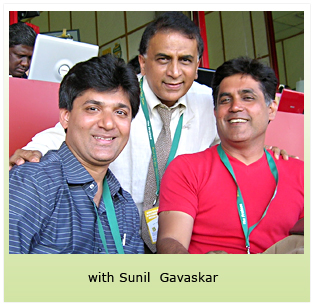
Founder Of The Dynasty

Its been twenty-two years now. Yet it all seems to have happened barely twenty-two minutes back!

The last day of MCC’s bicentenary test at Lords. A couple of hours to go before the match starts. I am standing at the practice zone towards the nursery end. Imran Khan is busy doing some stretching exercise. Must pounce on him the minute he is through. He has promised a write up for the special World Cup edition of the ‘Sunday’ magazine but has been dilly-dallying for the past two days. If I do not get it today, I am done for. Back then, the world was yet to hear about a gadget called the cell phone. No e-mails either. It is not possible to go running to Imran’s South Ken-sington flat to get the article. I do not have the address. Besides, it is ru-mored that only blue eyed, blonde models/actresses have exclusive access to the password there.


Crushing all these negative thoughts Imran himself called me. Which was quite surprising. So was his question, “What is this I hear, Sunil’s re-tiring?” I said yes, yesterday he had held a press conference after the match. It is all over the papers today. Imran said, “haven’t seen the papers this morning, But Sunil retired! What a shame, he did not even let me know!”

The topic for the ‘Sunday’ article was– My dream eleven for one dayers. But Imran appeared so distraught over the news of Sunil’s retirement that I felt he was ready to dump that topic into the waters of the Thames. And he did. “I’ll write about Sunil. Come with me.” The security personnel stopped me just outside the doors of the Lords dressing room– What’s this, a journalist here! But Imran fixed him with a glare, “he is with me.”

That was the first and the last time I got to enter the Lords dressing room– courtesy Sunil Gavaskar. It dawned upon me later that my physical presence in that dressing room was hardly needed for the article to take shape. For all I had done was switch on the cassette recorder and hold it. Imran had extempore dictated every word right down to the last punctua-tion. His tone so poignant, as if he had lost someone very dear. After the article was published by ‘Sunday’, Khalid Ansari, who is close to Gavaskar re-printed it in the ‘Sportsweek’ with ABP’s permission. And later on that was again re-printed by a Mumbai daily. Unprecedented. But then Imran’s emotional outpouring too was unprecedented.

The gist of which was, Sunil Gavaskar is not just the name of the tough-est batsman of the world, it also refers to the world’s sharpest cricketing brain. Imran had written, “People gush over Mike Brearly. What Brearly? I know Sunil to be a whole lot smarter. He was forced to be defensive be-cause he did not have fast bowlers.” At New Delhi last year, during the Silver Jubilee celebration of the eighty three World Cup win, Kapil Dev had expressed similar thoughts. “Sunil was not defensive. It’s just that he had no other option.” Just the day before the Sri Lankan Team bus was at-tacked at Lahore, Javed Miandad was felicitated at the Gaddafi Stadium for his induction to the ICC Hall of Fame. Miandad said on that occasion, “I am not for Sachin. He’s good no doubt but in my eyes Sunny and Viv are the greatest!”

Present at Gaddafi on that occasion was another ex-Pakistani star who during the sixties was a huge influence on the Mumbai cricketing scene – Hanif Mohammad. Gavaskar’s uncle Madhav Mantri used to say, “The visiting Pakistan team is playing against CCI at Brabourne. Getting down at Churchgate station, I’m about ten minutes late. From there, I hear the sound of bat on ball – crack. This sound means, who else! Must be Hanif batting!”

Crack – in later days that sound of the bat middling the ball meant but one name in world cricket. Invariably Gavaskar, who else! It is said the true evaluation of littérateurs begins some fifty years after their death. In case of sportspersons, that happens some two decades after they retire.

Appraised twenty two years later, Gavaskar emerges more sparkling, more flawless than ever before. Rather, a whole lot criticism that was aimed at him back in those days seem to be losing their edge. For example, batting left handed for over an hour during that Mumbai-Karnatak Ranji Match. At that time it was said that it was a display of unsporting behav-iour to kill the game. What was overlooked was the fact that nobody could get him out even when batting left handed. Today everybody marvels at how far ahead was he of his times. At the Knight Riders trial John Bu-chanan keeps insisting upon giving preference to ambidextrous cricketers, who can adapt their game according to the demands of the conditions. Left hander Raghuram Bhat was making the ball spin from outside the leg stump. Where there was a rough. The ball was pitching at a spot outside the batsman’s line of vision and turning. What had Gavaskar done? He switched to batting left handed. That way he could clearly see the move-ment of the ball right from where it pitched. Today Kevin Petersen does this quite regularly and its become famous as the switch hit.

After all these years, the checklist shows that there are two challenges that Gavaskar never had to face and which today make up the question pa-pers of the likes of Sachin. Firstly, the Doosra. Secondly, fielders like Jonty Rhodes. But then again, he had hit Iqbal Qasim through mid on-mid wicket on that terrible pitch in the last test innings of his career. So it can be assumed that he would have tackled the Doosra as well. Brilliant field-ers would have definitely prevented him from getting so many runs. Many of those missed catches would have been taken. He would get run out a few more times.

But at the same time, what if the likes of Sehwag had to answer the set of questions of Gavaskar’s time? Could they have been so flamboyant? No helmet for the first ten years of your career. Uncovered pitches. Inferior bats compared to what is available today. No limits to the number of bouncers bowled in an over. No neutral umpires. On the other hand there were the fiery fast bowlers of that era to reckon with. For example, when pitched against the West Indies it was not just a question of seeing off so and so’s spell. Out of the feared foursome at least two were constantly at-tacking from either end.

Long after his retirement, Clive Lloyd had told Anandabazaar, “Even while lauding Bradman, I somehow feel that four fast bowlers would have definitely troubled him. Just one Larwood was more than a handful for Bradman.” This one comment from Lloyd is the biggest tribute to Ga-vaskar!

In the eighty three Guyana test, Gavaskar was hit on the head by a Mar-shall delivery. The impact was so hard that the non striker feared it must have fractured the skull. Concerned, the West Indian fielders also came running. Gavaskar simply shook his head and wiped the sweat off his brow. Shadowed a forward defensive shot. Played the next ball forward as well. In those days, team physios were not in vogue. The team manage-ment sent twelfth man Kiran More into the field with some ice. Hearing a few choicest Marathi expletives flying around, More looked around him to find their source. Where are these coming from? The crowd? Are there some non resident Marathis on the stands? He quickly realized that they were pouring out from the striking end. Gavaskar does not want any ice.

The anecdote doesn’t end here. During the break a furious Gavaskar caught hold of More by his shirt in front of the dressing room. “Who asked you to bring the ice? Just give me his name!” Then he lambasted the rest of the team, “Aren’t you ashamed? Here we are fighting for the country and you give the impression that we are a bunch of sissies. You are bound to take a few hits when at war. But why show your wounds to your foe? Those feeling scared can take the first flight back home tomorrow.” The entire team, Kapil included, sat cowering in silence. And till today nobody has revealed who was responsible for the instantaneous reaction of sending the ice onto the field.

Much later I had it from Mohinder Amarnath, “Before the Guyana test, I had a few doubts about Sunny. But the way he handled that Marshall over convinced me. It was okay. This man deserved to be number one.” Kapil Dev – who was Gavaskar’s main rival back then, recently remarked, “As a batsman, Sunil was the champion. I’ve no qualms admitting that at least I have learnt my cricket from him.” Sunil and Kapil first met on the cricket field. It was 1978. And their very first meeting sparked off controversy. Kapil was bowling for the Wills XI. And the Maratha was immediately impressed. “Hey, you bowl well. But when you’re trying the out swing, bowl a little closer to the stumps. It will be more effective.”

Solid advice. But the inexperienced Kapil became hesitant during his run up. And the Wills XI raised a hue and cry, alleging that their new boy was being sledged. That was the beginning and since then the tension between the two icons has smouldered so intensely that in comparison Sourav vs. Greg Chappell is Kindergarten stuff. When that same Kapil says in over-whelmed tones, “Sunil taught us our cricket,” then it seems that things have come a full circle. Having distanced oneself from the immediacy of events, today its time to realize the true worth of Gavaskar!

This 10th of July, Gavaskar will be 60. I don’t know if that’s the reason but the cricket board’s media manager Devendra Prabhu Desai has re-leased his new book last month – SMG. There was no real expectation from the book since the author is a salaried worker of the board. And he would not dare to write anything controversial about the board’s favourite son.

But surprisingly, the five hundred pages between the covers touch upon quite a few controversial topics, without delving into which the Gavaskar saga can never be complete. West Zone vs. North Zone, media vs. him, In-dia vs. the rest of the cricketing world, Gavaskar and all the debate sur-rounding him.

The book is bound to stir a gamut of emotions in any cricket aficionado. Feelings akin to the nostalgia of walking down one’s old school corridors. There is the classroom…that, the teachers’ room… those the steps leading to the play ground…time has only cast its shadows. Memory has not been engulfed by the outstretched arms of the Banyan!

There is the young man storming into the scene in 1971…his exit too just as regal. Scoring 96 in the last Test of his career, a 188 in the last 5 day match he played…a century in his penultimate One day. And when was this meteoric rise? At a time when there was no economic liberaliza-tion. The country was yet to become a nuclear power. No Indian had made it to the list of ‘Global Business Tycoons’. The coinage Young India was unheard of. A vicious triangle of unemployment, inflation and license raaj had the nation paling under its stranglehold. Uncertainty and distrust had overtaken the minds of people. When afflicted by an acute inferiority complex, the hapless middle class would win only on the Silver screen – as the Angry Young Man.

This is where Gavaskar created a new tradition. Telling the middle class that you too can dethrone the monarch. And making them understand that there is indeed no romanticism in losing. A defeat remains a defeat, no matter how you lose. The other name of which is ruin. So do not lose. If you lack the caliber to win at least drag it to a draw.

Foreign cricketers like Imran have always felt that Gavaskar’s greatest achievement was to rid the Indian dressing room of a lack of self belief and instil this confidence that we too can play fast bowling. That goes without saying. Yet today I feel that his greatest contribution was opening up the golden gates of victory for the Indian middle class. In later days many have advanced following this route map to the mint. For example Sachin who has prospered even more. But the young man hailing from the lower middle class neighbourhood of Chekalwadi and a resident of Bhagi-rathi Buildings was without a doubt the founder of this dynasty. Someone who took Salim-Javed’s eulogy to the middle class out of the world of cel-luloid and turned it into reality for the man on the street. And this is what adds vitality to the Gavaskar saga even today.

It was towards the end of his career. Gavaskar was on his way to a for-eign tour. His friend Milind Rege was accompanying him to the airport. Along the way, Rege brought up the name of a young school cricketer. One who had been brilliant all season yet failed to get nominated for the honour of the best school cricketer that year. “He has become very de-jected at this injustice of the Mumbai Cricket Association.” The car was almost at the airport. Gavaskar asked, “What’s his name?” Rege said, “Sa-chin Tendulkar.”

At this Gavaskar stopped the car and leaning on the dashboard, wrote out a small note. “Dear Sachin, don’t be disheartened. If you go through the old list of Mumbai’s best School cricketers you’ll find one familiar name missing there. But that man has not done too badly in international cricket.” And thus was laid the foundation of the bridge between Gavaskar and Tendulkar.

In later years, given their individual professional success and the lime-light bestowed upon them by the outside world, there must have been mo-ments when sparks flew between the two Marathas. But in spite of all this, a grateful Sachin has always remembered how a legend extended his hand to help a completely unknown young boy. The two met for the first time on one of the most heart-rending days of Indian cricket. 6th November, 1987. The day from which Gavaskar’s corporeal presence and cricketing skills ceased to exist in the Indian dressing room. Sachin was a ball boy that day for the Reliance Cup semi-finals. He looked at the hero from afar yet could not meet him. But seeing the kind of adulation being bestowed upon Gavaskar by the media, Sachin reiterated his pledge– if I am to be-come a cricketer, I must be like this man!

Other scions, still unknown to the world were likewise getting inspired then. Like Rahul Dravid. At that time, the Dravids were residents of In-dore. Still not old enough for pads and gloves, young Rahul was immersed in the world of book cricket. But here too, getting a century under Ga-vaskar’s name was paramount. Any less and the game stopped there. And Sourav Ganguly? Three years after Gavaskar’s retirement, Saurav was on his way to Bangalore to attend his first India trials. On board the airplane, he came across a familiar journalist from Calcutta. In the course of their conversation Sourav said, “Whatever you say, just two people in India de-serve to be Boss. Sunil Gavaskar and Amitabh Bachchan.” Virendra Sehwag is such a swashbuckling bat. But if Gavaskar’s batting is sweet pomegranate, then Sehwag’s is like banana. Both are fruits – that’s where the similarity ends. Yet, Sehwag too cannot get over the exhilaration sur-rounding Gavaskar that he had known during his early teens.

To be honest, even at the threshold of 60 Gavaskar remains the terms of reference for Indian batting. And a glittering souvenir of the triumph of the middle class! In the pre-Gavaskar era the reins of Indian cricket were in the hands of the elite. That changed ushering in social equality.

There’s an incident that I’ve never written about before now. India has lost to Viv’s West Indies at Sharjah. Gavaskar having opened the batting under Kapil’s orders was playing a long innings. But the four West Indian pacers did not let him come anywhere near the target. I was taking down Tiger Pataudi’s expert comments for the next day’s paper. I asked, could India have won the match if we had adopted a different batting strategy?

Pataudi said, “I don’t know why even after seeing that mid on was up, Mr. Gavaskar did not try playing his shots. If he had started doing so five overs earlier, we would not have been in this mess.” I asked, was it possi-ble that he had not noticed? Pataudi: “Impossible! The nitty-gritty’s of field placing would never escape his notice.”

Just when I was getting all excited thinking here’s a great quote for my write-up, the Nawab poured water over my hopes, “Don’t write all this though.” Why? That mid on was up is merely a technical observation.

“Still,” Pataudi appeared quite perturbed, “No need. He might retaliate with some write up. That would be deadly.”

After all these years writing it down gives me a heady feeling– The mon-arch’s trepidation. And the common man’s usurpation of the throne.
Sorry – Ascension!


© Copyright 2013 Gautam Bhattacharya. All rights reserved.